Running k3s on Apple's container runtime — HA clusters, one micro-VM per node
Every local-dev Kubernetes tutorial puts all nodes on a shared kernel. Apple's container runtime breaks that assumption — one micro-VM per node, real DHCP IPs, no Docker daemon. The interesting part came when I tried to make the control plane highly available.
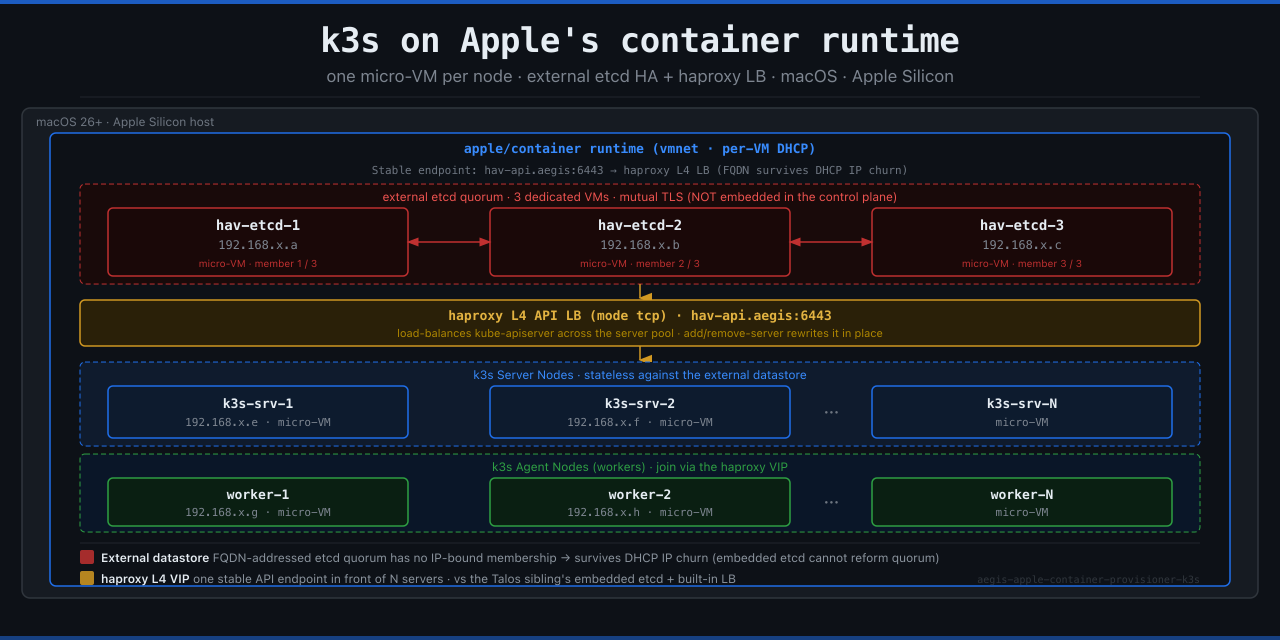
Local Kubernetes on a Mac has a quiet assumption underneath it: all nodes share one kernel. kind, minikube, Docker Desktop’s built-in cluster — they run nodes as processes or containers on the host kernel, not as real machines. That’s fine for most purposes; the Kubernetes API looks the same either way.
Apple’s container, shipped with macOS 26, changes that assumption. Each Linux container is a lightweight micro-VM with its own kernel, its own init process (vminitd), and a DHCP-assigned IP on Apple’s vmnet. The isolation is closer to a real machine than to a Docker container.
@saiyam1814’s kiac was first to prove Kubernetes works on this substrate, using kubeadm, single control plane. I wanted to see the k3s path, and specifically what happens when you try HA. My Talos sibling project covers the immutable-OS take on the same substrate — including the DHCP story and the micro-VM recipe in depth — so I’ll keep the substrate background brief here. This post is the k3s take, and the HA path is where it gets its own story.
The result is k3ac (“k3s + apple container”) — a standalone Go launcher that provisions k3s clusters as per-node micro-VMs on apple/container. v0.6.0, all hardware gates green.
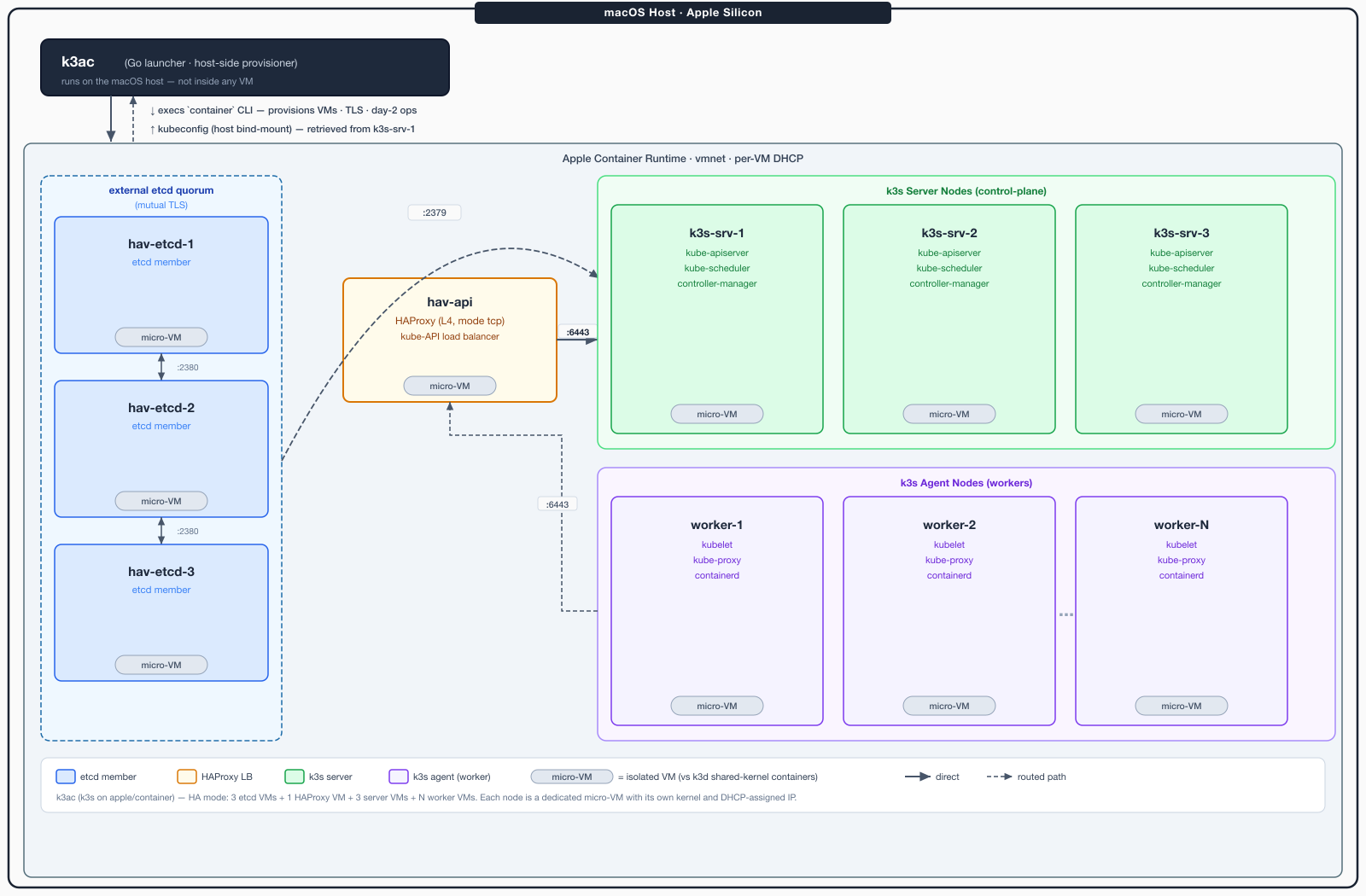 Single-node default uses sqlite embedded in the k3s server VM. HA mode (shown) adds a 3-node etcd quorum and an haproxy L4 API load balancer — all as micro-VMs on the same vmnet, each with its own DHCP IP.
Why k3s, and why a freestanding launcher
k3s fits the apple/container substrate well. It’s a self-contained binary that embeds its own containerd; it doesn’t expect systemd or a pre-existing container runtime socket. It boots under vminitd — k3ac’s gate G1. Flannel’s host-gw backend gives clean pod-to-pod routing across micro-VMs on the same vmnet (gate G2, 0% packet loss both ways).
There is no upstream interface to implement. The Talos sibling satisfies siderolabs/talos/pkg/provision.Provisioner — a clean Go interface that let the out-of-tree implementation compile straight against the real Talos provisioner machinery. k3s has no equivalent. There is no plugin loader, no extension point, no merge path. k3ac is a freestanding launcher that execs the container CLI to boot k3s nodes as micro-VMs. The exec-the-CLI pattern is carried over verbatim from the Talos sibling; the freestanding shape is different because the upstream is different.
The DHCP constraint, and why it hits etcd harder in HA mode
Both the Talos sibling and k3ac share the same substrate constraint: vmnet assigns each node’s IP by DHCP. There is no static-IP option. After a cold restart — stopping and restarting the container daemon, or the VMs themselves — DHCP may hand out different addresses.
For single-node k3s on sqlite this is handled cleanly. k3ac uses FQDN naming via Apple’s container DNS: each node is <cluster>-server-1.<domain>, the kubeconfig endpoint is the FQDN, and the API server cert covers the FQDN as a SAN (not the IP). After a DHCP shift the FQDN still resolves; the kubeconfig stays valid. Gate G5 verifies this.
For a multi-server HA control plane, the same DHCP constraint runs directly into etcd’s internals. And that is where the embedded-etcd path dies.
The embedded-etcd dead end
k3s supports two HA control-plane paths:
--cluster-init(embedded etcd, peer-to-peer between server nodes). This is what the k3s HA quickstart shows first. It needs no extra infrastructure.--datastore-endpoint(pluggable external datastore; server nodes are stateless against it). This needs an external etcd or SQL database.
The natural instinct is --cluster-init. I tested it. It does not survive a cold restart on this substrate.
Here is the mechanism: embedded etcd’s peer membership is IP-bound. Each member stores the other members’ peer URLs as https://<IP>:2380. When you cold-restart all three server VMs, vmnet DHCP hands out new addresses. The etcd members come up and try to contact their peers at the old IPs. Nothing answers. Quorum never forms. The cluster is permanently stuck; you destroy and recreate.
This is not a k3ac bug or a k3s bug. It is a fundamental collision between etcd’s membership model and a DHCP substrate. etcd stores IP addresses as peer URLs because that is how the Raft membership protocol works — changing a member’s peer URL requires a membership reconfiguration operation, not just a restart. The cluster doesn’t know that the IP changed; it just sees an unreachable peer.
The ADR documents the verification sequence: bring up embedded etcd HA, cold-restart all server VMs, observe the quorum failure, confirm the peer URLs in etcd’s member list contain the old IPs. Gate G9 is the hardware verification of the external-datastore fix.
The fix is --datastore-endpoint, addressed by FQDN. An external etcd cluster reached by FQDN (not IP) has no IP-bound membership problem. The k3s server nodes reconnect to the same FQDNs after a DHCP shift and resume normally. k3ac auto-provisions this when you pass -servers N with no explicit -datastore-endpoint.
What the HA design looks like
One command provisions the full stack:
1
go run ./cmd/k3ac -name hav -servers 3 -agents 1
The provisioner runs this sequence:
1. Generate a TLS bundle on the host. Pure stdlib crypto/x509 — no external tooling. One CA, one server cert per etcd member (SANs: member FQDN + localhost + 127.0.0.1, never the DHCP IP), one k3s client cert. The FQDN SANs keep TLS valid across DHCP shifts because no IP is ever in a SAN.
2. Provision a 3-node etcd quorum. Three micro-VMs — hav-etcd-{1,2,3} — running quay.io/coreos/etcd:v3.5.16. The TLS bundle is delivered via the same host bind-mount mechanism used for kubeconfig delivery (see below). Each member’s FQDN is registered in Apple’s container DNS. The provisioner waits for each member’s client port to become reachable before proceeding.
3. Provision an haproxy API load balancer. One more micro-VM — hav-api.<domain> — running haproxy in mode tcp. TCP passthrough; it does not terminate TLS. The kubeconfig endpoint is https://<cluster>-api.<domain>:6443. The API server cert covers that SAN. Adding or removing a server node rewrites the haproxy config in place.
4. Bring up server nodes. Each wired to the external etcd via --datastore-endpoint, with --tls-san covering both the server’s own FQDN and the LB address.
5. Bring up agent nodes against the LB endpoint (K3S_URL=https://<cluster>-api.<domain>:6443).
The 3-node etcd quorum (rather than a single-VM datastore) tolerates losing one member and keeps serving. Member count is configurable via -datastore-members (must be odd and ≥ 3). You can also bring your own datastore: -datastore-endpoint 'postgres://user:pass@db.aegis:5432/kine' skips the auto-provisioning entirely.
Single-node default skips all of this. Embedded sqlite, no etcd, no haproxy, no extra VMs.
Two gotchas the substrate adds regardless of HA
Two constraints bite before the HA question even comes up. Both are shared with the Talos sibling, but worth naming here because the failure modes are non-obvious.
The container cp vsock fault. The obvious way to retrieve the kubeconfig from inside a VM is container cp. It doesn’t work reliably during k3s cold boot. k3s unpacks a large bundle of embedded container images on first start; this saturates the guest (vminitd) during the unpack. The saturation faults the vsock channel that container cp rides over. The cp is killed externally by the platform — verified against a 180 s timeout that the kill arrives well before, not at. A faulted vsock also wedges container stop and container rm for two or more minutes afterward — hardware-verified.
k3ac avoids the guest agent entirely for the critical path. The host cluster state directory is bind-mounted into the VM at create time. k3s writes its kubeconfig to that bind-mount via --write-kubeconfig /mnt/k3s-out/k3s.yaml --write-kubeconfig-mode 0644. The provisioner polls os.Stat for the file on the host side — no vsock, no container exec, no container cp. Readiness is a direct TLS dial from the host to https://<server-fqdn>:6443. The full analysis is in ADR-0001.
The silent apiserver OOM. At tight server memory the Kubernetes API server can be OOM-killed with no crash log — the VM stays up but the cluster never becomes ready. Steady-state k3s usage is around 620 MB, but the boot window needs headroom above that; the default is 2 GB for this reason. The failure mode is completely silent — no explicit error, just a cluster that never becomes ready. The Talos sibling has the same constraint; it’s a Kubernetes-on-micro-VM floor, not a k3s-specific one.
Day-2 operations, hardware-verified
A design goal that separates k3ac from a spike script: the day-2 operations work and are hardware-verified on Apple Silicon. All destructive verbs require -force; without it the command prints the plan and exits non-zero — a dry-run guard.
Snapshot and restore. -snapshot saves the managed etcd datastore to a host-side file (timestamped, under _out/clusters/<cluster>/snapshots/). -restore rebuilds all etcd member data volumes from the snapshot. Snapshot is safe; restore requires -force.
Rolling upgrade and rollback. -upgrade <cluster> -image rancher/k3s:v1.33.0-k3s1 -force replaces nodes one at a time: servers first, then agents. Each node is stopped, reprovisioned at the new image, and waits for Kubernetes readiness before the next one proceeds. After a DHCP IP change the node re-registers to the cluster by FQDN — the FQDN endpoint handles the re-registration transparently. -rollback returns to the image pinned at the last upgrade.
Cert and token rotation. -rotate-certs regenerates the entire TLS bundle (CA + all member/client certs) and redelivers it to all etcd members and k3s servers. -rotate-token generates a new K3S_TOKEN and re-registers all servers and agents against it. Both require -force.
These are verified at gates G15–G17 in docs/VERIFICATION.md — first-person runbook with exact commands, not just unit assertions.
What it doesn’t promise
k3ac is a proven spike, not maintained tooling. The honest limits:
No upstream merge path. k3s has no pkg/provision.Provisioner-style interface. There is nothing to contribute upstream. k3ac will not become a k3s CLI subcommand; it is a freestanding launcher that lives here.
Clusters do not survive a host reboot. Apple’s container DNS domain (sudo container system dns create <domain>) does not survive a macOS restart. Neither does the vmnet DNS registration. After a full host reboot you recreate from scratch (~4–5 minutes for HA). After a cold-restart of just the VMs (stopping and restarting nodes without rebooting the host), -stop and -start preserve the cluster data — FQDN addressing handles the DHCP shift.
This is not for production. Same scope as k3s’s own embedded-mode documentation: local development, CI validation, ephemeral test environments. The HA design makes the cluster resilient to VM restarts, not to host reboots, which is the right tradeoff for the use case.
The differentiator from the Talos sibling
The Talos sibling uses Talos’s embedded etcd. It does not hit the IP-bound membership problem the same way, because the Talos provider’s DHCP reconciliation runs before etcd ever starts — the endpoint is patched to the real DHCP address before the node boots with its config. The embedded etcd binds the correct IP from the start.
k3s’s HA path doesn’t have that seam. k3s’s --cluster-init forms the cluster after boot, and by the time you restart the cluster, the peer URLs are already baked with the first-boot IPs. There’s no pre-boot config patch to hook into. That’s why k3ac’s HA path is external datastore rather than embedded etcd — and why it needs the extra etcd VMs and haproxy that the Talos sibling doesn’t.
| Aspect | Talos sibling | k3s (k3ac) |
|---|---|---|
| Datastore | Embedded etcd inside control-plane nodes | External 3-node etcd quorum + haproxy LB |
| Extra VMs for HA | None | 3 etcd members + 1 haproxy LB |
| DHCP handling | Pre-boot config patch (endpoint is the real IP) | FQDN addressing throughout; IP is never in a peer URL or SAN |
| Day-2 ops scope | Full Talos lifecycle (via talosctl) | Snapshot/restore, rolling upgrade, cert/token rotation (k3ac verbs) |
The k3s lane costs more VMs for HA. It also delivers something the Talos lane currently doesn’t: a full day-2 ops suite hardware-verified on this substrate.
Code: github.com/BinHsu/aegis-apple-container-provisioner-k3s. ~9,480 LOC Go, 4-job CI (lint / race-detector tests / govulncheck / gitleaks), ADR trail, hardware verification log.
This site is the lab side of my work. The polished portfolio lives at binhsu.org.