Platform metrics are four promises, not a list to memorize
Every platform-engineering interview eventually asks how you measure the platform. The weak answer recites DORA. The strong one knows the metrics group into four promises a platform makes — and that most teams only keep two of them. The full reference table, and the one family almost everyone forgets.
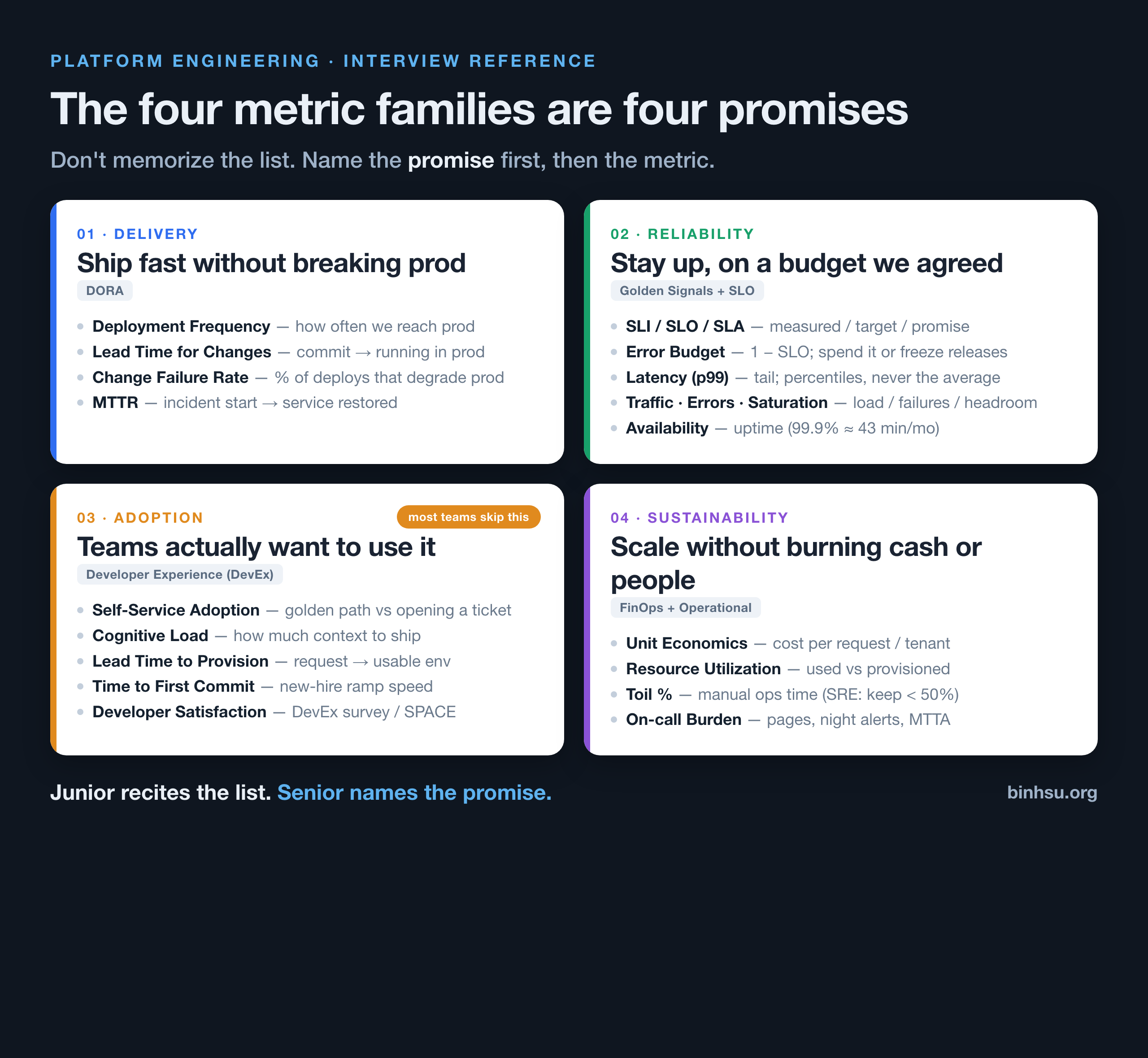
Every platform-engineering interview eventually reaches the same question: how do you measure the platform? And most candidates answer it as a memory test — they list DORA, maybe SLIs and SLOs, drop a “p99” to sound senior, and stop.
That answer is fine. It’s also forgettable, because it treats the metrics as a flat pile of acronyms. The metrics aren’t a list. They’re four promises a platform makes to the company that pays for it — and the senior move is to name the promise first, then reach for the metric that proves it.
Promise 1 — Delivery: we ship fast without breaking prod
This is the DORA family, and it’s the one interviewers reach for first. Two of its four metrics measure speed; the other two measure stability. The senior framing is that these are not a trade-off — the whole reason a platform exists is to raise both at once.
| Metric | What it measures | Elite benchmark |
|---|---|---|
| Deployment Frequency | Successful prod deploys per unit time | On-demand / many per day |
| Lead Time for Changes | Commit → running in production | < 1 day |
| Change Failure Rate | % of deploys that degrade prod (hotfix / rollback / patch) | 0–15% |
| MTTR | Incident start → service restored | < 1 hour |
Promise 2 — Reliability: we stay up, on a budget we agreed
This is the SRE vocabulary: the Four Golden Signals (Latency, Traffic, Errors, Saturation) plus the SLI / SLO / SLA objective layer and the error budget that makes reliability a negotiated number instead of an absolute.
| Metric | What it measures |
|---|---|
| SLI | A measured signal of behavior — e.g. successful ÷ total requests |
| SLO | Internal target for an SLI — e.g. 99.9% over a 30-day rolling window |
| SLA | External promise, with penalties — looser than the SLO, leaving a buffer |
| Error Budget | 1 − SLO. Spend it on releases; exhaust it and you freeze them |
| Latency | p50 / p95 / p99 — always percentiles, never the average |
| Traffic | Load — requests/sec, QPS, concurrency |
| Errors | Failure rate — 5xx, failed-request ratio |
| Saturation | How close resources are to their ceiling — CPU, memory, IO, pool |
| Availability | Uptime — and the “nines” cost more than people think |
The availability number is where interviews catch people, because the downtime math isn’t intuitive:
| SLO | Downtime / month | Downtime / year |
|---|---|---|
| 99% | ~7.2 hours | ~3.65 days |
| 99.9% | ~43 minutes | ~8.76 hours |
| 99.99% | ~4.3 minutes | ~52.6 minutes |
| 99.999% | ~26 seconds | ~5.26 minutes |
Promise 3 — Adoption: teams actually want to use what we built
Here is the family almost everyone forgets — and forgetting it is the difference between a platform engineer and someone who runs infrastructure. Delivery and reliability measure whether the platform works. Adoption measures whether it was worth building.
| Metric | What it measures |
|---|---|
| Self-Service Adoption | % of work done via the golden path / portal vs opening a ticket |
| Cognitive Load | How much tooling and context a developer must hold to ship (Team Topologies) |
| Lead Time to Provision | Request an env / DB / cluster → it’s usable (ideal: minutes, self-serve) |
| Time to First Commit | New-hire join → first merged PR / first prod deploy |
| Developer Satisfaction | DevEx survey, NPS, the SPACE framework |
The principle: a platform is an internal product, and a product is measured by whether people choose it. The example: I have seen platforms that were green on every DORA and SLO target and still failed, because teams routed around them — they opened tickets, kept their own pipelines, and the “platform” was a tax nobody asked for. The punchline:
A platform that’s reliable but unused isn’t a platform. It’s a house nobody lives in.
If you measure only Promises 1 and 2, you can build that house and never know.
Promise 4 — Sustainability: we scale without burning cash or people
The last promise is the one that decides whether the platform survives its own success. It has a money half (FinOps) and a human half (operational toil and on-call).
| Metric | What it measures |
|---|---|
| Unit Economics | Cost per request / per tenant / per transaction |
| Resource Utilization | Actual usage vs provisioned — catches over-provisioning |
| Toil % | Engineering time on automatable manual ops (SRE guidance: keep < 50%) |
| On-call Burden | Alert volume, night pages, MTTA (time to acknowledge) |
Cost and toil are the same failure in two currencies: a platform that scales by spending more dollars, or by spending more of its team’s nights, is not scaling. It’s deferring a bill.
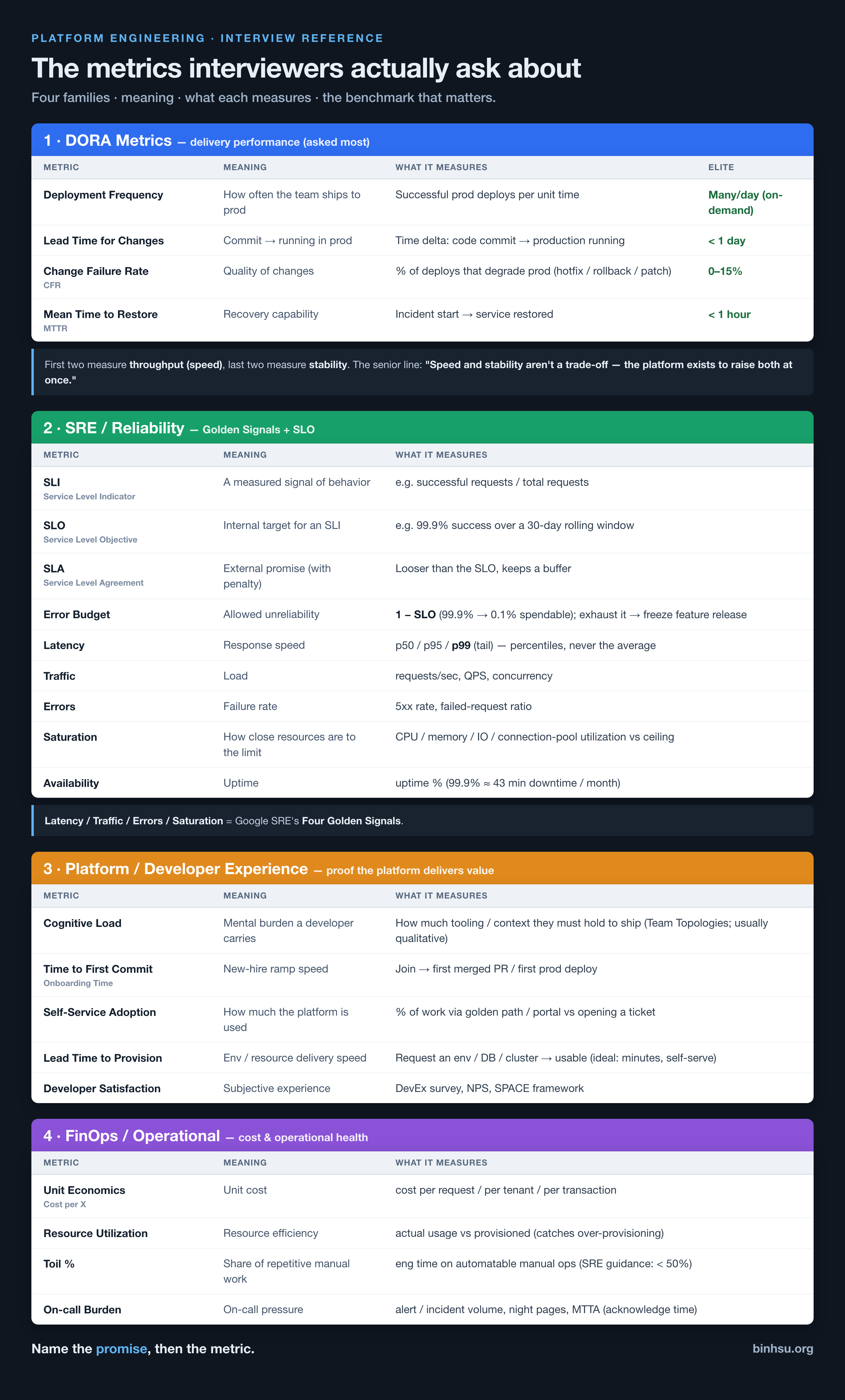 The complete reference — save this one. Every metric above, with its meaning, what it measures, and (for DORA) the elite benchmark.
How to actually answer the interview question
When they ask “how do you measure your platform,” don’t open the acronym fire-hose. Lead with the promises, and let each one pull in the metric that proves it:
“I measure a platform against four promises. Delivery — are teams shipping fast without breaking prod; that’s DORA. Reliability — are we up, against an error budget we agreed; that’s SLOs and the golden signals. Adoption — do teams actually choose the platform over routing around it; that’s self-service adoption and cognitive load, and it’s the one most teams forget to measure. And sustainability — does it scale without burning cash or people; that’s unit economics and toil. The first two say it works. The last two say it was worth building.”
That answer is the same length as reciting DORA. It just shows you know what the numbers are for.
The card at the top is a one-screen version of this reference — save it. The depth, the benchmark tables, and the availability math are here. The point that’s worth carrying away without any of the tables: reliability proves the platform works; adoption proves it was worth building, and that’s the promise most teams never put a number on.