After Jenkins, GitHub Actions feels fragmented
The thing you miss isn't Jenkins — it's a single control plane
Companion piece: AWS CLI or AWS MCP? — same line of thinking: keep the control plane separate from the thing that executes.
I grew up on Jenkins. A year into GitHub Actions, the word I keep reaching for is fragmented.
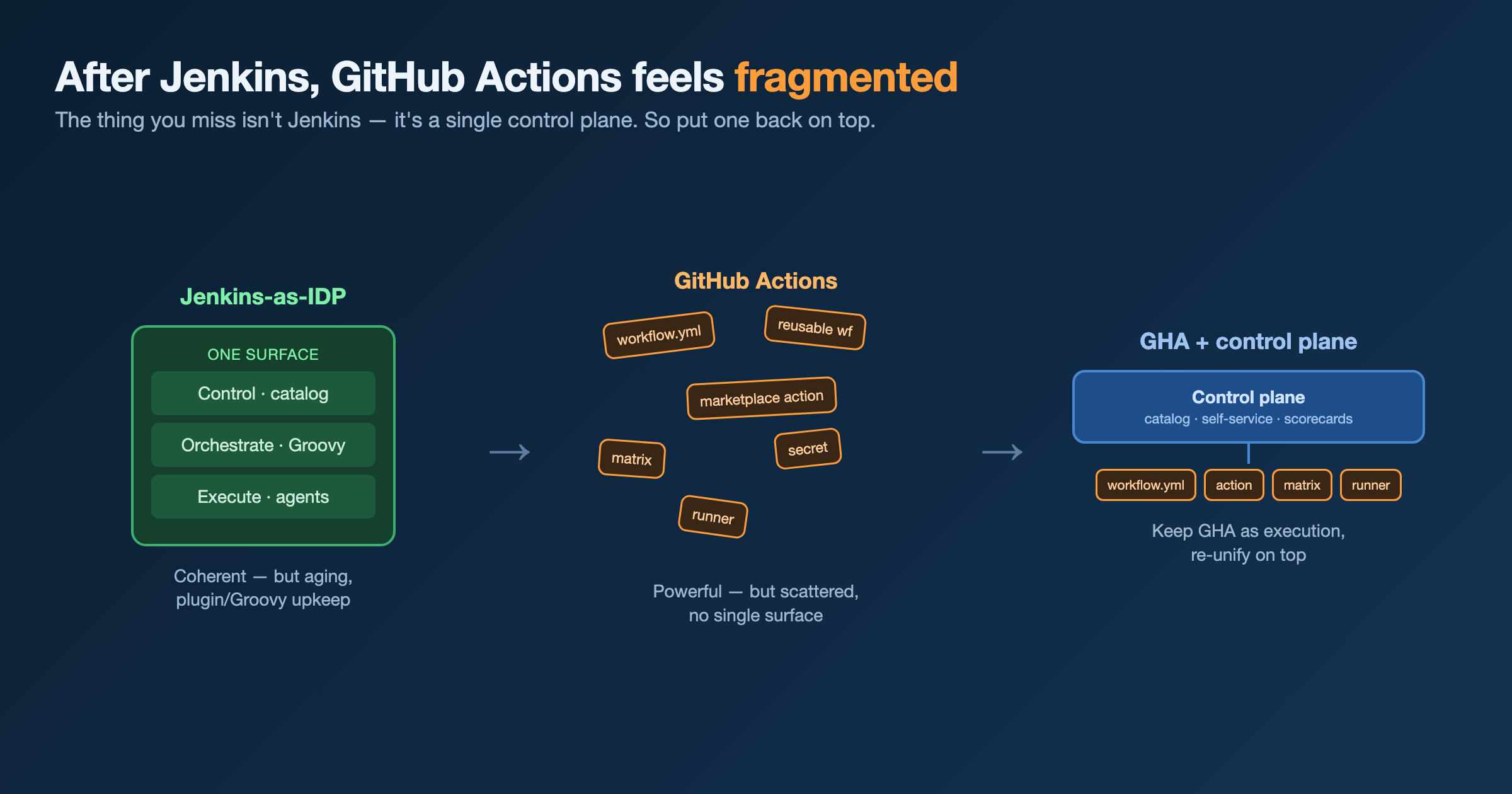
Not worse. Fragmented. On Jenkins my pipelines, my shared logic, my self-service jobs, and my run history all lived in one place I could reason about. On GHA the same capability is real — but it’s scattered across YAML files, repos, marketplace actions, reusable workflows, and ephemeral runners. The feeling has a cause, and it has a fix that isn’t “go back.”
What you’re actually missing
People say they miss Jenkins. Pin it down and it’s almost never the tool — it’s the single, programmable control surface.
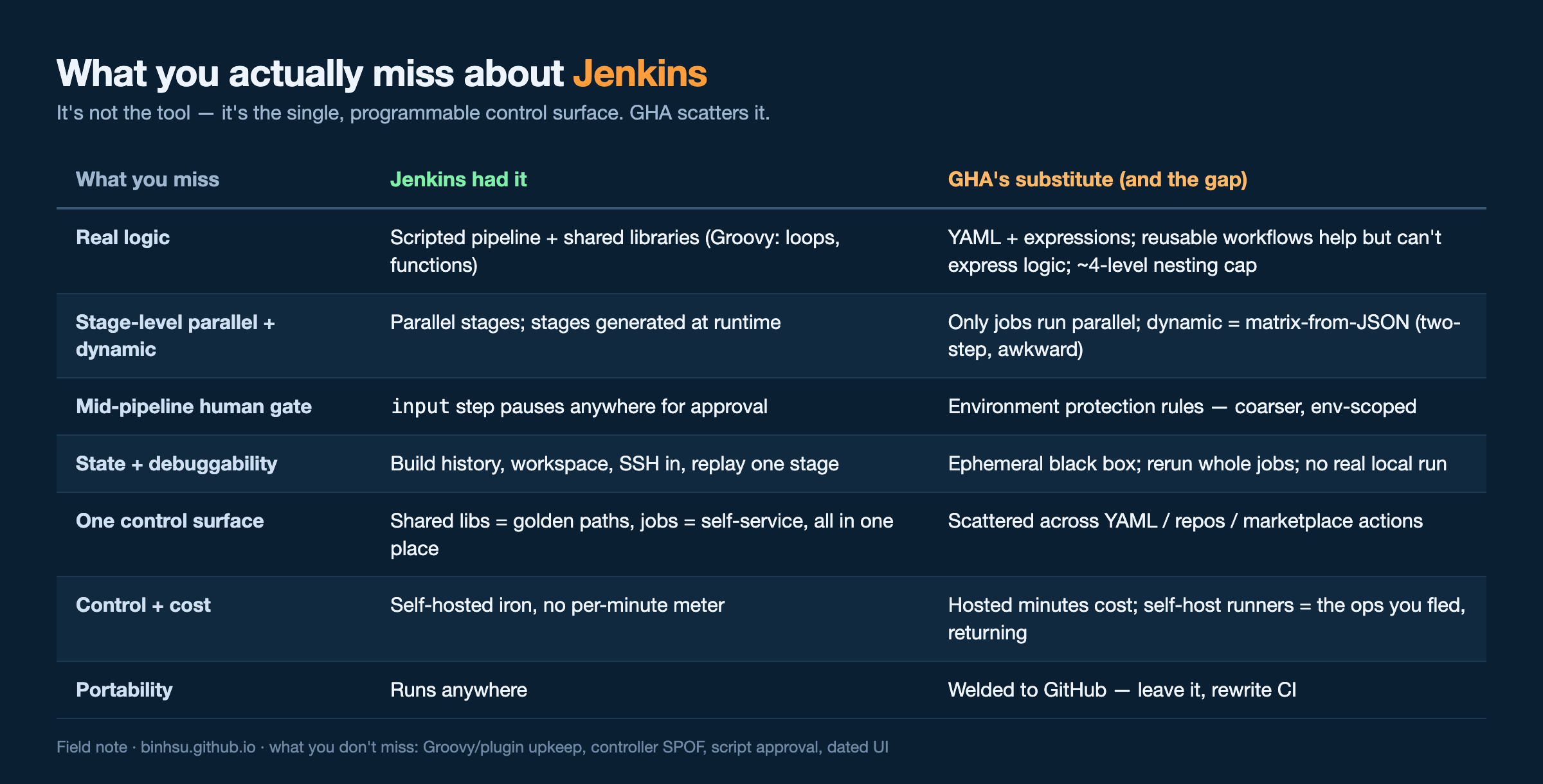
| What you miss | Jenkins had it | GHA’s substitute (and the gap) |
|---|---|---|
| Real logic | Scripted pipeline + shared libraries (Groovy: loops, functions) | YAML + expressions; reusable workflows help but can’t express logic; ~4-level nesting cap |
| Stage-level parallel + dynamic | Parallel stages; stages generated at runtime | Only jobs run parallel; dynamic = matrix-from-JSON (two-step, awkward) |
| Mid-pipeline human gate | input step pauses anywhere for approval | Environment protection rules — coarser, env-scoped |
| State + debuggability | Build history, workspace, SSH in, replay one stage | Ephemeral black box; rerun whole jobs; no real local run |
| One control surface | Shared libs = golden paths, jobs = self-service, all in one place | Scattered across YAML / repos / marketplace |
| Control + cost | Self-hosted iron, no per-minute meter | Hosted minutes cost; self-host runners = the ops you fled, returning |
| Portability | Runs anywhere | Welded to GitHub — leave it, rewrite CI |
And the honest other half: nobody misses Groovy upkeep, plugin CVEs, the controller as a single point of failure, script approval, or a UI stuck in 2012. The migration is usually right. The nostalgia is for the coherence, not the maintenance.
Why it fragments
An IDP has three planes. Jenkins, grown into a platform, collapses all three into one tool — which is why it feels coherent and why it ages badly:
- Control — catalog, ownership, self-service (Jenkins: folders + parameterized jobs)
- Orchestration — turn intent into config (Jenkins: Groovy shared libraries)
- Execution — actually build and deploy (Jenkins: agents)
GitHub Actions is excellent at execution and deliberately doesn’t pretend to be the other two. So the moment your needs grow past “build and test,” the control and orchestration that used to be one Groovy library are now spread across a dozen YAML files. That spread is the fragmentation.
The fix: re-unify on top, don’t retreat
Two wrong moves: mourn it in YAML, or rebuild Jenkins-as-IDP. The right move is to put a thin control plane back on top of GHA and let GHA stay the execution engine.
In order of effort:
- Use GHA’s own structure first. Org-level reusable + starter workflows, repository templates,
workflow_dispatchfor self-service, CODEOWNERS for ownership. Many teams stop here — and should, until the pain is real. - Add a control plane when you’ve outgrown that. Port is the shortest path: it auto-builds a catalog from your repos and triggers your existing workflows via
workflow_dispatch— the execution layer doesn’t move. Its free tier is unusually generous (15 seats, 10k entities, unlimited data sources and catalog pages), so you can prove the whole loop at zero cost. Be clear-eyed about the trade, though: Port’s edge agents are open source, but its core is a closed, hosted SaaS — the generous free tier is land-and-expand, and what you buy long-term is lock-in. Backstage is the same control-plane idea if you’d rather own it than rent it — you swap the lock-in for the maintenance. - Know what your suite does and doesn’t do. If you’re on Atlassian, Compass observes GHA (catalog + scorecards from build/deploy metrics) but cannot trigger it — its only scaffolding feature was removed at the end of 2025. It’s a governance layer, not a self-service portal over GHA.
Port’s tiers at a glance — a snapshot pulled on 2026-05-30:
| Plan | Price | Seats | Entities |
|---|---|---|---|
| Free | $0 | up to 15 | up to 10k |
| Basic | $30 / seat / mo | up to 50 | up to 50k |
| Standard | $40 / seat / mo | up to 200 | up to 250k |
| Enterprise | Custom | Custom | 1M+ |
Pricing moves — this is a same-day snapshot. Always treat the official Port pricing page as the source of truth going forward.
The Free plan already includes unlimited data sources, catalog pages and AI agents — enough to prove the loop before you pay a cent. (Generous on purpose: it’s the land-and-expand funnel from the caveat above.)
Why Port and not the hotter Backstage? Backstage is the name everyone reaches for — the CNCF darling, the default answer. But here’s the trap, and it’s the whole point of this post: Backstage is heavier to maintain than the Jenkins you’re trying to leave. Jenkins, for all its age, is a stable CI server — you set up pipelines and they run. Backstage is a bespoke React/Node application you own as source: a plugin tree on a fast-moving npm core, breaking changes between versions, upgrades teams dread and postpone. You’re not adopting a product; you’re signing up to build and operate a custom web app. So reaching for Backstage to escape platform-maintenance moves you in the wrong direction — toward more of it. Port earns the default precisely because it deletes that burden: managed core, a catalog that builds itself, no app to keep alive. Reach for Backstage only when you genuinely need to own the control plane and have a platform team to keep it breathing — not because it’s the one on everyone’s slides.
The migration posture is strangler-fig: stand the control plane in front, move the highest-traffic self-service actions to it (backed by the GHA workflows you already have), and let “Jenkins-as-IDP” thinking fall away one job at a time.
The one line to keep
What you miss isn’t Jenkins. It’s being able to orchestrate everything from one place you can reason about. GHA modernised execution and gave that coherence away. You get it back by adding a control plane on top — not by retreating to the monolith you already outgrew.
Field note. The Jenkins-vs-GHA gaps are well-trodden; the Compass and control-plane specifics were checked against current vendor docs as of 2026-05-29.